The decay of the House of Usher
The Fall of the House of UsherThe decay of the House of Usher is at once architectural, familial, and narrative: an ancient but seemingly coherent mansion bears a nearly invisible crack, while the family whose name it shares approaches extinction. The building’s deterioration first appears contained within its walls; by the ending, the fissure has opened into a rupture that accompanies the deaths of Roderick Usher and Madeline Usher and the mansion’s descent into the water.
The Building and Its Fissure
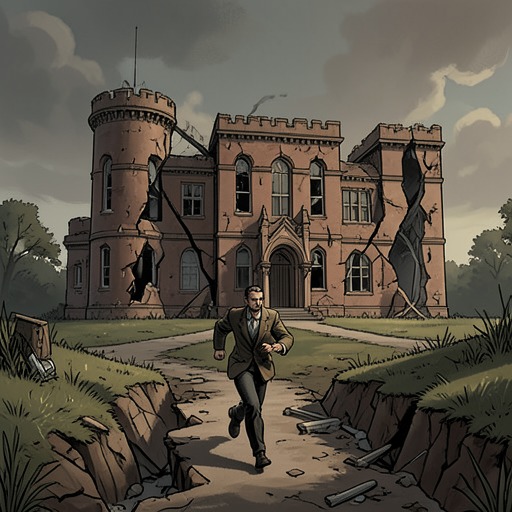
The narrator initially sees a structure marked by extreme age rather than obvious ruin. Discoloration covers the exterior, and fine, tangled fungi hang from the eaves, yet no masonry has fallen. The individual stones crumble even as the parts remain fitted together, an unsettling contrast between local deterioration and the appearance of an intact whole. The house seems stable, but that stability is already qualified by the material condition of its fabric.
A barely perceptible fissure descends in a zigzag from the roof on the building’s front wall toward the tarn beside the Usher house. Its narrowness makes it easy to miss; its course, however, connects roof, wall, and water in a single visible line. The narrator first registers it as a minor feature in an otherwise standing structure. At the end, that same crack widens rapidly, making the early description a precise foreshadowing of the house’s destruction.
The building’s aged surfaces and the fissure are distinct signs of decline. The first suggests long, gradual deterioration; the second gives that deterioration a concentrated path through the structure. The narrator’s initial impression of a peculiar, oppressive atmosphere around the mansion remains his impression rather than an established physical cause, but it makes the house’s material condition difficult to separate from the story’s mounting sense of threat.
Family, Inheritance, and the House’s Name
The Usher family’s history gives the mansion’s decay a longer frame. The family is ancient and known for unusual sensitivity, artistic achievement, unobtrusive charity, and devotion to intricate musical forms. Its lineage, however, has produced no enduring collateral branch: the family has remained almost entirely in a direct line of descent. The narrator considers whether this restricted succession helped bind the people and their property together over generations.
That bond is preserved in the name House of Usher, which, in the narrator’s account, refers both to the family and to its mansion. The estate’s title has become an equivocal name for people and place alike, so the building is not simply a dwelling owned by a family. Its identity has become difficult to distinguish from theirs. The eventual destruction of the mansion therefore coincides with the end of the family line rather than standing as an isolated architectural disaster.
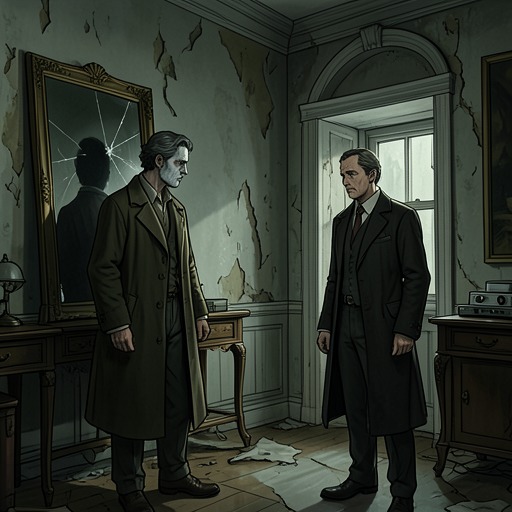
Roderick’s account of his sister’s approaching death makes that inheritance unusually immediate. Madeline is his sole companion and last living relative; he fears that her death will leave him the final member of the ancient family. The narrator later learns that the twins have long shared a profound, difficult-to-explain sympathy. Their relationship intensifies the association between the house’s singular fate and the survival of its occupants, without establishing that the building itself literally feels or acts.
Decline Within the House
The mansion’s internal spaces carry the story’s deterioration beyond the exterior. Roderick has lived within the house for many years and, according to the narrator, has not ventured outside. The deep, dim tarn and the mansion’s walls and turrets have, in Roderick’s view, exerted an influence on his spirit. The narrative presents this belief alongside a more immediate source of distress: his severe nervous disorder and Madeline’s prolonged illness. The house thus becomes the setting in which bodily vulnerability, inherited isolation, and fear accumulate, rather than a proven supernatural cause of them.
After Madeline is reported dead, Roderick decides to keep her body temporarily in a vault within the mansion’s main walls before final burial. He gives practical reasons: uncertainty surrounding her unusual illness, the medical men’s inquiries, and the remote, exposed location of the family burial ground. The narrator agrees to help, partly because he regards the measure as a precaution and recalls the family physician’s troubled manner. Their decision places the family’s most consequential uncertainty beneath the same structure already marked by age and an overlooked crack.
The vault lies deep below the narrator’s sleeping quarters. It is small, damp, and without natural light; its long access passage and interior are sheathed in copper, as is the heavy iron door. The place had apparently served as a medieval prison and later as storage for gunpowder or another combustible substance. These details make the mansion’s foundations a repository of old uses and present anxieties. When the coffin is briefly opened, the narrator notices the twins’ strong resemblance and learns that their sympathetic bond dates back through their lives. The body’s appearance is consistent with the cataleptic character of Madeline’s illness, leaving the question of her condition unresolved at the moment of entombment.
Rupture and Destruction
In the days after the entombment, Roderick’s conduct changes markedly: he abandons ordinary occupations, moves restlessly through the rooms, and speaks with habitual, tremulous fear. During a storm, the narrator reads aloud from The Mad Trist. As the successive sounds in the tale are followed by corresponding noises in the house, Roderick finally discloses that he has heard movements from the coffin for days and believes Madeline was buried alive. His admission recasts the temporary entombment from a cautious response to uncertain illness into a fatal failure to recognize that she remained alive.
Madeline returns to the room after escaping the vault. Roderick dies as she falls upon him in her final agony; the two twins’ deaths leave no surviving Usher to continue the family line. The narrator flees the mansion and crosses the old causeway as the storm continues. In the light of the setting moon, he sees the previously described fissure widen. The walls rush apart, and the House of Usher’s fragments disappear beneath the tarn beside the Usher house.
The ending completes the story’s linked patterns of structural and familial decline. The mansion had seemed whole despite its crumbling stones, and the fissure had seemed too slight to threaten it; both appearances give way at once. The House of Usher does not merely become an abandoned ruin: it collapses after the deaths of the twins and sinks from view, bringing the shared name of family and dwelling to its final, literal break.